

 Your local contact:

GLP2-BASIC
High-Voltage Testers
High-voltage AC test equipment
Multitest testers with high-voltage AC/DC, insulation
GLP2-BASIC high-voltage testers are used to test the electrical insulation properties and dielectric strength (clearance and creepage distances) of electrical components, assemblies, and devices. Testing can be performed manually using safety test guns or automatically run. The testers support programmed test sequences.
The high voltage is generated electronically and adjusted fully automatically using ramp profiles. An " rotary button " is available on the front panel for manual tests.
Our devices provide an extremely stable and precise TEST VOLTAGE —ideal for individual part inspections as well as type and material testing.
Key Facts:
- AC High-Voltage Testers up to 6 kV
- RMS Voltage and Current Measurement
- Switching on and off at zero crossing
- Test current up to 100 mA
- DC High-Voltage Testers up to 6 kV
- Measurement of the mean
- Test current up to 100 mA
- Evaluation criterion: Leakage current
- Electronic test voltage control
- Adjustable voltage profiles
- Modes: Automatic, Manual, and “Burn”
11 Product Variants
Show all 11 product variants


The GLP2-BASIC high voltage test device . Excellent technology in a rugged package.

The high voltage test is housed in a compact enclosure built-in —with a wide range of configuration options and expansion levels. The device is clearly structured and streamlined to the essentials: everything you need for safe and efficient high voltage test .
The software also stands out for its clear layout and intuitive user interface, which makes your daily testing routine much easier.
All hardware and software are developed entirely in-house. True to our "Made in Germany" motto, everything is manufactured at our plant in the Sauerland region.

- GLP2-BASIC for 19-inch control cabinets
- Unit dimensions suitable for 19-inch racks
- Flexible interfaces
- Full remote control is possible
- Communication with:
- PC
- Master computer
- PLC
The ports on the back of the device
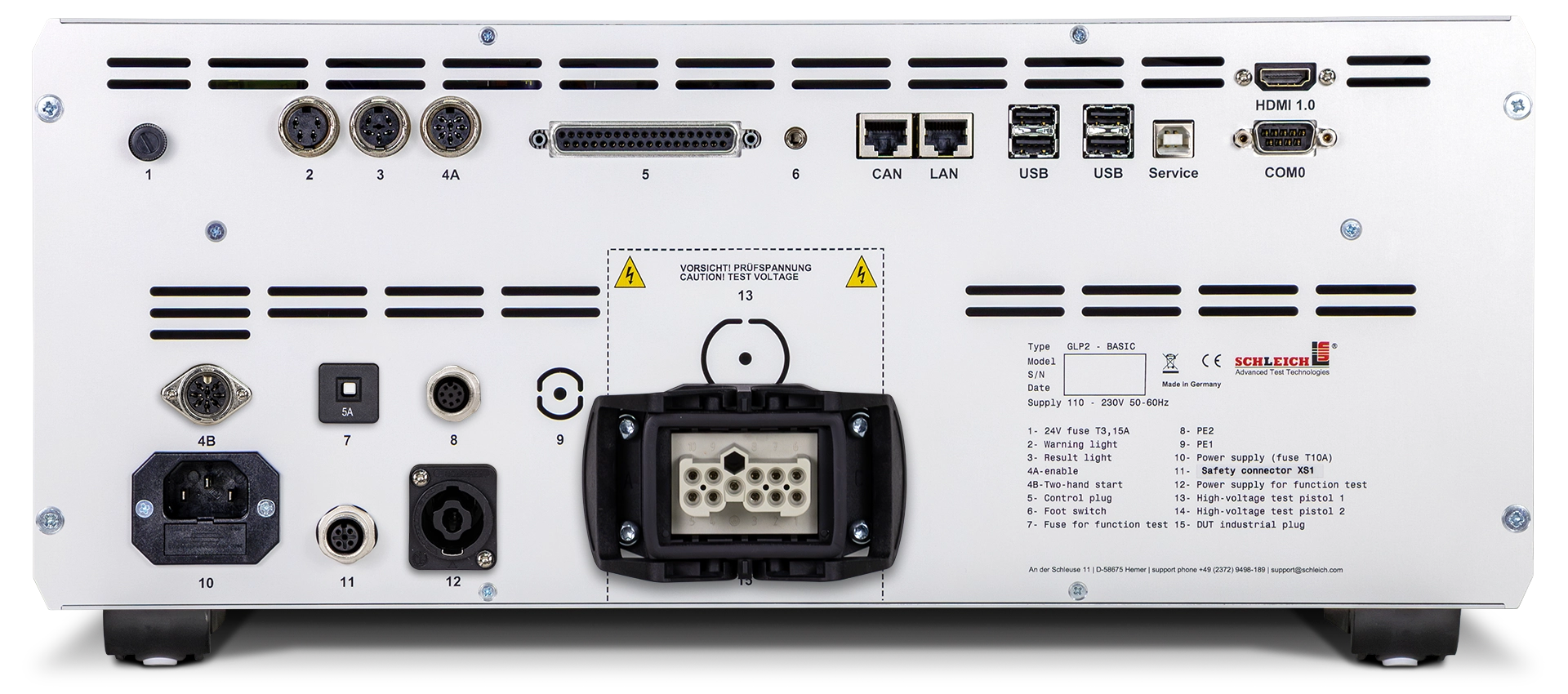

Standard equipment
Function and Technology
- Manual test sequence
- Semi-automatic test sequence
- Fully automatic test sequence
- 4 GB of internal database storage
- Integrated test plan database for up to 10,000 test plans
- Integrated test results database for up to 250,000 test steps
Communication
- RS232, USB, or LAN for " save " of the test results on a PC using the free SCHLEICH PC software PrintCom
- Printing Test Reports with PrintCom
- RS-232, USB, and LAN automation interfaces
- Easy remote control thanks to SCPI communication
- Communication via LabVIEW drivers
- Remote control via I/O
- 4 free 24 V inputs, optionally expandable
- 16 available 24 V outputs, optionally expandable
- CAN bus for external relay matrices
- Barcode and Data Matrix functionality available
- Option for remote maintenance and remote calibration
safety
- 2-channel safety inputs in accordance with EN 50191
- Warning light traffic signal connection
- Scoreboard connection
- connection for test cover, foot-switch, external safety switches, door contacts, light curtains, emergency stop buttons, two-hand controls, etc.
- key switch for devices without a safety current limit
- Safety and Warning Messages
- Built-in validity checks
- Integrated, explanatory help texts for each input field
- Meets the requirements of EN/IEC 61010-2-034
The automatic test sequence
The GLP2-BASIC runs on the streamlinedWindows® Embedded operating system. You always have a clear overview of all relevant test results . The clear display of the test sequence enables structured and highly efficient work.
In automatic mode, the tests are performed semi-automatically or fully automatically. The tests run step by step, fully automatically, between all test ports connected to the device under test .
If, for example, the operator needs to manually scan individual measurement points on the device under test using a test probe, the test is paused with the message " messages." This pause lasts until the operator has completedthe manualtask. Afterward, the testresumes fullyautomatically. The test results are automatically evaluated and clearly displayed.
The test sequence can be edited by simply adding or removing test steps. This allows the test sequence to be optimally adapted to various requirements. Each individual test step can be configured custom using test parameters.
The comprehensive integrated user management system ensures that only authorized individuals can make these changes run .

The input
To edit the inspection steps, simply open them. The inspection criteria ( test parameters ) can be easily modified, and the inspection instructions ( test sequence ) can be adapted to the inspection task. All entries are automatically checked for validity. There is no need to use a cumbersome inspection plan editor. For each inspection criterion ( test parameters ), you can view informative explanations regarding the corresponding inspection instruction ( test parameters ) by clicking the question mark button.
test parameters s are visible to all users, but can only be modified by authorized personnel.
The data
GLP2 stores test plans and test results either locally or on a shared network drive on the company network. We recommend connecting the test devices to the network.
This has the following advantages:
- All test devices on the network access the same test plans.
- All Test testers are built to the same specifications.
- Centralized data storage for all inspection systems within a global network makes it easier for you to ensure the quality of your products worldwide. Regardless of location.
- Test plans can be viewed and edited on PC workstations regardless of the testing equipment.
- test results can be displayed, analyzed, and printed at PC workstations.
The scripts
The scripting language provides an easy-to-understand and very powerful tool for customizing and tailoring the GLP2 to specific needs.
This offers the following advantages:
- Custom adjustments by the operator
- Sequence control, as in a PLC
- Adaptation to complex barcode content
- and much more
The manual check
GLP2-BASIC provides you with access to all integrated test methods individually—as if you had a separate test device for virtually every test method .
No test plan is required to use the unique manual mode. The operator simply selects the desired test method and starts the tester.
The most important measurement values are displayed in large digits. The other settings are also clearly displayed. This feature is unique. It is ideal for testing in the lab or at the repair station.


Manual mode
Select the desired " test method " and start the measurement. To finish, stop the measurement.
However, no comparison with threshold values is performed. Instead, the measured values and the set test conditions are displayed continuously.
test parameters s can be adjusted via the touchscreen while the measurement is in progress. This is a major advantage. As a result, your device under test is continuously exposed to the test conditions. You can put it through its paces and subject it to stress for as long as you like.
Not only can the test conditions—such as TEST VOLTAGE and Test current —be modified, but the displayed actual values and their physical units can also be switched to suit the desired analysis.
For testers with multiple test ports, the test methods can be switched to the available test ports—just as with the automatic “ test sequence.” It doesn’t get any better than this, as it allows manual measurements to be performed between any two test ports. The test ports are conveniently selected via the touchscreen. The integrated relay matrix handles the “ switch-over .”
automatic test method switch-over , and Mechatronics

Testing technology from SCHLEICH has proven itself time and again in daily use. It ranks among the most reliable products on the market and offers high utility value thanks to its outstanding performance and accuracy.
To save time, all connections on the test object can be made using a contact adapter. The tester then performs the specified tests fully automatically without any manual intervention. This is made possible by SCHLEICH’s signature “ automatic test method switch-over .”
For test objects with multiple connections, it is more cost-effective to connect all of the test object’s connections to the test equipment immediately. The test equipment then performs all tests between all connection points fully automatically. This approach reduces the required clock rate and, consequently, the cost of a test. The “ switch-over ” between the various connections is achieved through flexible switching matrices.
To minimize the time required for the “ connection ” of a test object with many connections, we implement the frequently requested dual-station or multi-station systems. In this setup, the object is loaded and un discharge d at one station while testing is performed simultaneously at the other stations. This approach allows for highly cost-effective results even during complex and extensive tests.
Test method switching
Depending on the type and scope of the test methods provide , a large number of switching operations are required. These to ensure enable a fast and automatic switch between the various test methods. Since the voltage differences between the test methods can be very large, safety is the top priority during these switching operations. A Resistance test with 3 V is switched to the device under test just as reliably as a high voltage test with 6000 V—to protect your employees and the test object. And we do so without compromise! That is why, for switching circuits and matrices, we use only high-quality components—proven tens of thousands of times over—from our own production or from renowned manufacturers.
Dies
We provide have the right relay matrix for virtually any application. The matrices differ in the number of connections and the voltage level of the signals to be switched TEST VOLTAGE. A matrix must switch 6,000 V just as safely and reliably as it does millivolt signals. That is exactly why our engineers developed these matrices. The matrices are designed for two- and four-wire applications. They can be daisy-chained to increase the number of connections as needed. Matrices with more than 100 connection points are not uncommon. The same principle applies to matrices as to test method switches: only the highest quality components are used.
Station switching
Instead of using two or more test devices, station switching can be a cost-effective alternative, for which we also impose the highest safety requirements. While testing is underway at one test station, the other test station is being set up or discharge. In doing so, the operator inevitably comes into contact with terminals and connecting cables. Touching the terminals and connecting cables poses a potential electrical hazard. Therefore, the test leads to the stations where no test is currently taking place must be safely disconnected. In addition, it is recommended to ground the connections to the device under test .
Mechatronics | Script Control
In addition to the hardware, the software also offers tremendous flexibility. Using the built-in script commands, you can implement additional PLC functionality in the test set. Just as with a PLC , you can query inputs, set outputs, and create logical connections.
The economic benefit lies in the direct control of mechatronic functional sequences. You can activate valves, query limit switch , evaluate measured values yourself, and much more. The test device is thus capable of generating additional functional sequences before, during, and after the test. This is ideal for custom test setups or for integration into an automated manufacturing process.
Test Methods

high voltage test DC
insulation test is performed using an electronically controlled, constant high voltage. During the test, the Test current must not exceed a specified maximum value. If the current rises above the maximum value, the test is automatically Cancelled. At the end of the test, the test object is always discharge .
high voltage test AC
insulation test is performed using an electronically controlled, constant high voltage. During the test, the Test current must not exceed a specified maximum value. If the current exceeds the maximum value, the test is automatically Cancelled. At the end of the test, the test object is always discharge .

ARC detection
ARCs are partial discharges that occur during AChigh voltage test s at or above a certain TEST VOLTAGE . ARC detection is a useful complement to high voltage test.
- Detection and counting: If an ARC exceeds the defined threshold, it is counted.
- Synchronized evaluation: The counting duration corresponds to one high-voltage cycle—at 50 Hz, this is 20 ms.
- Error criterion: If the number of ARCs in a given period exceeds the configurable threshold, an error is detected in the device under test .
The test protocol
All test results can be output in the modern standard protocol format either immediately after the test or at a later time. The language of the report can be selected at custom before it is generated. Reporting is performed in accordance with IEC 61934. The default languages are German, English, Chinese, Danish, French, Italian, Dutch, Polish, Portuguese, Swedish, Slovenian, Spanish, Czech, and Hungarian.


The " test protocol " shown here is an example; it displays a " protocol " from a multifunction tester.
Printout on paper
Any Windows® 10-compatible printer GLP2-BASIC be connected to the GLP2-BASIC . As is standard in Windows®, simply click the printer icon, and all measurement results will be printed automatically.
Create a PDF file
If desired, the GLP2-BASIC generates a PDF file that is saved to USB drive, the internal hard drive, or any network path. Saving to USB drive occurs fully automatically in the root directory. No “copy and paste” in Windows® is required.
Generating a CSV file (optional)
Optionally, the GLP2-BASIC can also generate a CSV file following a test sequence . The file is saved to any network path. The data transferred to the CSV file is fully configurable and can be customized to meet your needs.
The GLP2-BASIC Technology Package

The GLP2 expansion with the Technology Package takes full advantage of the extensive capabilities of Windows®. The display appears on an external touchscreen monitor, with the screen layout dynamically adapting to the monitor’s resolution. The user interface is even more intuitive and organized than the standard version. A full-featured PC is used to enhance performance.
The proven measurement hardware and precise measurement technology are identical to those of the standard unit. The Technology Package represents an upgrade in terms of usability.
Thanks to the Windows® PC, the large touchscreen, and the resulting technical capabilities, the user interface is even more informative and user-friendly than ever before. Our engineers have consistently leveraged all the modern features of the Windows® operating system. The result offers a clear, no-frills layout that’s a sight to behold.
In addition to the standard software's features, a test plan revision function—including comprehensive test plan history management— built-in. New or modified test plans can be approved according to the dual-control principle. Test plans are approved by a reviewer, not by the person who created them.
GLP2-BASIC Network
Test plans and test results can be stored locally or, alternatively, on a central network drive. This ensures a high level of safety for your data as well as optimal data exchange of test plans between different test systems.
Even in its basic configuration, the GLP2-BASIC network-ready. This feature provides the ideal platform for collecting, managing, analyzing, and distributing information.
With an additional technology package, the GLP2-BASIC also offers the option of integration into a complex enterprise environment and can be linked with ERP, PPS, MES, and CAQ systems. To meet this requirement, provide offers tried-and-tested, configurable solutions.
network outage

Each testing device automatically saves local copies of the current server test plan database so that it can continue operating in the event of a network outage.

In the event of a network outage, the local test plans are used, and the test results is stored locally on the test device.

Once the network connection is restored, the test device automatically sends the test results back to the server, ensuring that the server'smemory is once again up to date.
Comprehensive global network for test equipment with a technology package

The testing devices can be operated in network topologies of any complexity. You can install an unlimited number of testing devices at various company locations worldwide and connect them to the central network drive. Our experience in the global networking of testing devices gives you the safety to ensure consistent product quality regardless of the production location. Problems with revising test plans are now a thing of the past.
Of course, all test plan, print, label, and statistical tasks can also be performed on the individual test devices run. However, to avoid disrupting the production process, it makes sense to use separate workstations for these tasks in networked systems.
The editor&printer PC software can therefore be installed on various workstations.
Label templates can also be stored centrally on a network drive. The testing device then loads the appropriate template based on the test plan and prints the labels after the test. Storing the templates centrally on the network drive ensures that all connected testing devices always use the same label template.
If remote maintenance is necessary, we can temporarily connect to your network and access the specific testing device directly. We can see the device’s screen in real time. With your permission, we would also have access to the mouse and keyboard. These capabilities are ideal for providing expert support. Of course, remote maintenance is only possible with your authorization.
PC software editor and printer

Edit test plans
Test plans are often created directly on the testing device. Alternatively, test plans can be managed, edited, and saved on a PC using theeditor&printer software, which is included free of charge with the device. Creating test plans on a PC has the advantage of not disrupting ongoing production. Work can continue on the testing devices. The software interface on the PC is similar to that on the testing device. As a result, operation is virtually identical and therefore easy to learn.
The software is used in two modes:
- Data transfer via USB flash drive | Offline operation
- Data exchange via PC network | Online operation
Printing Test Results
The software makes it easy to create and print test reports. To do this, import the " test results " from a test device, filter the data based on the tests you want to print, and generate detailed, easy-to-read reports.
All the facts at a glance
Stand-alone testers for HV AC/DC, PE, or insulation
Combination testers with up to 21 test methods and integrated test method switching


- Insulation testers up to 6 kV
- AC High-Voltage Testers up to 6 kV
- DC High-Voltage Testers up to 6 kV
- All test methods are controlled fully electronically and wear-free
- High voltage with ramps for acceleration and deceleration
- High voltage with voltage profiles
- Step voltage measurement
- Fully and semi-automatic testing
- Manual checks
- Compliant with EN 50191 (Installation and Operation of Electrical Test Systems)
- 2-channel safety inputs
- PL e, SIL 3, Cat. 4 safety circuit (depending on device model and hazard level)
- Safety circuits with positively driven safety relays
- High process reliability
- Intuitive user interface via a 7-inch touchscreen plus HDMI—connection
- Additional input via keyboard and mouse is possible
- Scanning any 1D and 2D barcodes
- Ethernet, WiFi, USB, and serial interface
- Integrated “PLC ” functionality via a freely programmable scripting language
- Communication via RS232 and/or standard SCPI commands
- memory for test plans and test results
- User Management
- Report printing
- Fully customizable label printing for thermal transfer printers
- Can control multiple label printers
- Full network connectivity
- Option for remote maintenance or remote calibration
- Remote control capability for automation
- Includesan editor and printer for save and for printing test results on a PC
- Remote-controlled for automation
- Benchtop or 19-inch rack-mount device for automation
- Standard model/standard version in stock or with very short lead time
- Ideal for OEMs
- Includes a traceable factory calibration certificate
- Includes SCHLEICH.CARE.PREMIUM
Downloads
German PDFs

Do you need personalized product advice?
We'd be happy to provide provide you with comprehensive support and advice on all our products and services.
Give us a call or send us an email!