

 Your local contact:

GLP2-BASIC
leakage current test devices
Test devices for leakage current tests in combination with function test
The GLP2-BASIC leakage current test devices reliably determine whether impermissible currents flow through the insulation to earth or touchable metallic housing parts. The test can be flexibly designed: either manually using test tips or as an automated process.
The leakage current test is typically performed simultaneously with the function test. The test device is therefore designed as a combination test device that combines both procedures for an efficient test sequence.
Key Facts:
- Function test up to 260 V AC
- Electronic voltage adjustment
-
Leakage current 1 µA – 30 mA
-
Autorange across 5 measurement ranges
-
max. 500 Hz
- Standards EN60990, EN60601
-
- Combination with further safety tests is possible
10 Product Variants
Show all 10 product variantsThe GLP2-BASIC. Excellent technology robustly packaged.

The integration of up to 21 test methods in a compact device is unique in this class. The GLP2-BASIC offers a clear and concise display of tests, and the intuitive operating concept significantly simplifies the daily testing routine.
100% Made in Germany: Hardware and software are exclusively developed and manufactured by Schleich at its Sauerland location. This consistent quality forms the basis for innovations that set global standards in safety and function testing.

The GLP2-BASIC is designed for seamless integration into production lines. Thanks to the standardized 19" housing with mounting frame, the test device integrates perfectly into your system. Flexible interfaces thereby ensure complete remote controllability as well as easy connection to host computers or PLCs.
The Connections on the rear of the device
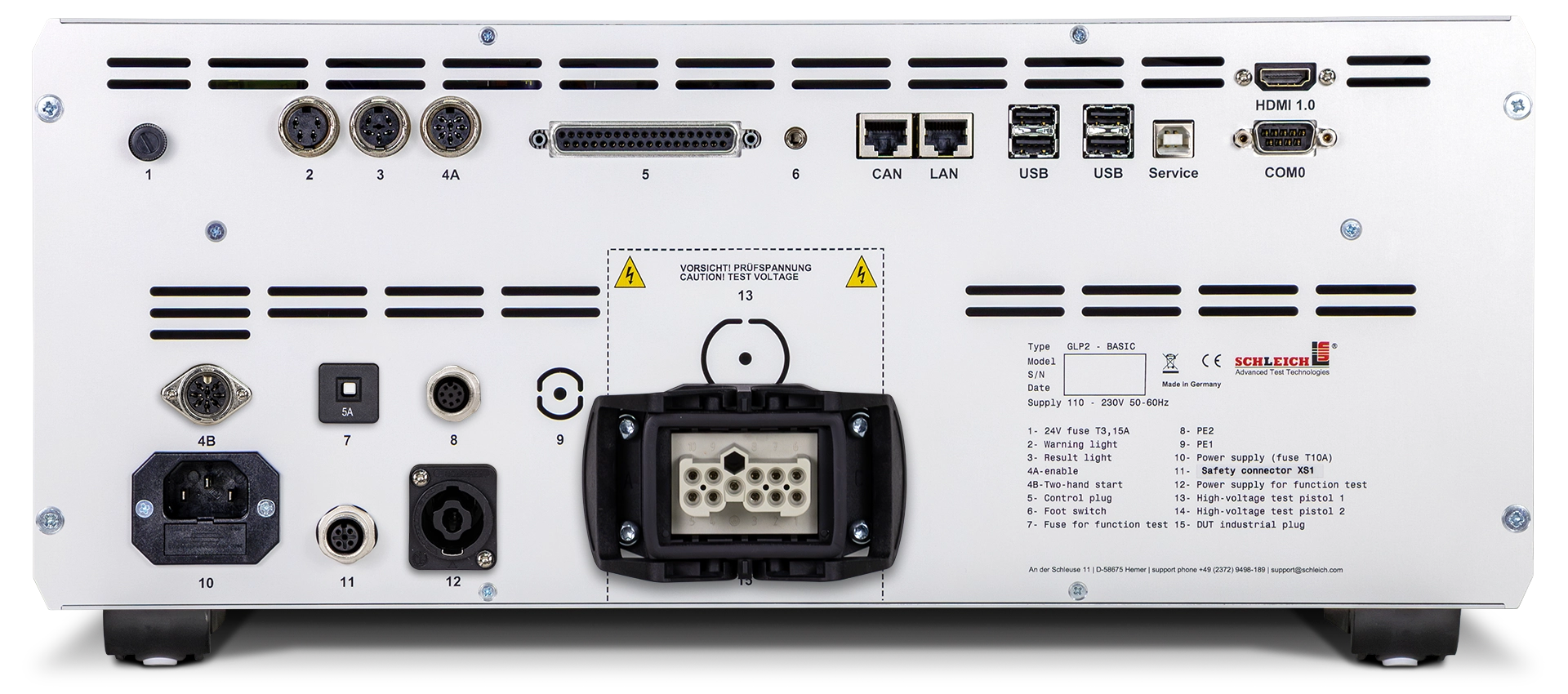

The Standard Equipment
Function and technology
- Manual test sequence
- Semi-automatic test sequence
- Fully automatic test sequence
- 4GB internal memory
- Built-in test plan memory for up to 10,000 test plans
- Built-in results memory for up to 250,000 test steps
Communication
- 2 x USB on the front panel
- Rear panel
- 4 x USB
- 1 x LAN
- 1 x RS232
- 1 x CAN
- USB/RS232-COM automation interface
- Ethernet SCPI automation interface
- Ethernet Interface for saving on the LAN network
- Capability for remote maintenance and remote calibration
- 4 x free 24 V input
- 16 x free 24 V output
- Communication with PC software
safety
- Two-circuit safety inputs according to EN 50191
- Warning light stack connection
- Result indicator light connection
- connection for test cover, foot-switch, external safety switches, door contacts, light curtain, emergency stop, two-hand operation etc.
- Safety and warning messages
- Integrated plausibility checks
- Integrated, explanatory help texts per input
- Meets the requirements according to EN IEC 61010-2-034
The Automatic Test Sequence
The GLP2-BASIC utilizes the lean Windows® Embedded. You always have a clear overview of all relevant test results. The clear display of the test sequence enables structured and highly efficient work.
In automatic mode, tests are run semi-/fully automatically. Between all measurement connections connected to the device under test, the tests run fully automatically step by step.
If the operator, for example, needs to manually scan individual measurement points on the device under test with a test probe, an interruption with a message will occur. This interruption persists until the manual task is completed. Subsequently, the test resumes fully automatically. The test results are automatically evaluated and presented clearly.
The test sequence is edited by simply adding or removing test steps. This allows the test sequence to be optimally adapted to various requirements. Each individual test step is custom configurable using test parameters.
The comprehensive built-in operator management ensures that only authorized persons can run these changes.

The Input
To edit the test steps, they are simply called up. The test parameters can be easily changed, and the test sequence can be adapted to the test task. All inputs are automatically checked for plausibility. Operating a cumbersome test plan editor is not necessary. For each test parameter, informative explanations for the respective test parameter can be displayed by clicking the question mark button.
The test parameters are visible to every operator but can only be changed by authorized persons.
The Data
The GLP2 stores test plans and test results either locally or on a shared network drive within the company network. We recommend networking the test devices.
This offers the following advantages:
- All test devices in the network access the same test plans.
- All test devices test according to the same specifications.
- Centralized storage for all test systems in a global network makes it easier for you to ensure the quality of your products worldwide, regardless of location.
- Test plans can be viewed and edited at PC workstations independently of the test device.
- Test results can be displayed, evaluated, and printed at PC workstations.
The Scripts
The script language provides an easy-to-understand and very powerful tool for the customization and specific adaptation of the GLP2.
This offers the following advantages:
- Custom adaptations by the operator
- Sequence control as in a PLC
- Adaptation to complex barcode content
- and much more
Manual Testing
The GLP2-BASIC provides all built-in test methods individually – as if you had a separate test device for each test method.
No test plan is required for using the unique manual mode. The operator simply selects the desired test method and starts the test device.
The most important measured values are displayed in large digits. Other settings are also clearly visualized. This function is unique and ideal for tests in the laboratory or at the repair station.


The Manual Mode
Select the desired test method and start the measurement. To finish, Stop the measurement.
However, no comparison with limit values takes place. Instead, the measured values and set test conditions are continuously displayed.
During the ongoing measurement, the test parameters can be adjusted via the touch display. This is a significant advantage. Your device under test is continuously exposed to the test condition, allowing you to test it thoroughly and load it for as long as you wish.
Not only are test conditions such as TEST VOLTAGE and Test current adjustable, but the displayed Actual values and their physical units can also be switched to suit the desired evaluation.
In test devices featuring multiple test connections, the test methods can be switched to the available test connections, mirroring the automatic test sequence. This offers optimal flexibility, allowing manual measurements to be performed between any test connections. Test connection selection is conveniently managed via the touch display, with the built-in relay matrix handling the switch-over.
The automatic test method switch-over and Mechatronics

Test technology from SCHLEICH has proven itself thousands of times in daily use. It is among the most reliable products on the market and provides high utility value through excellent performance and accuracy.
To save time, all Connections of the device under test can be connected using a contacting adapter. Subsequently, the test device performs the intended tests fully automatically without manual intervention. This is achieved by the SCHLEICH-typical automatic test method switch-over.
For devices under test with multiple Connections, it is more economical to connect all Connections of the device under test immediately to the test device. The test device then performs all tests fully automatically between all Connection points. This approach reduces the required cycle rate and thus the cost of a test. The switch-over between the various Connections is achieved by flexible switching matrices.
To minimize the time required for the connection of a device under test with many connections, we implement the frequently requested double or multi-station systems. In this setup, loading and discharge occur in one station while testing simultaneously in the other stations. In this way, very economical results can be achieved even with complex and extensive tests.
Test method switch-over
Depending on the type and scope of the test methods, we provide a variety of switch-overs. These to ensure a fast and automatic change between the different test methods. Since the voltage differences between the test methods can be very large, safety is paramount for the switch-overs. A Resistance test with 3 V is switched just as reliably to the device under test as a high voltage test with 6000 V. For the protection of your employees and the device under test. And that without compromise! Therefore, for switch-overs and matrices, we only use tens of thousands of times proven, high-quality components from our own production or from renowned manufacturers.
Matrices
We provide the suitable relay matrix for almost every task. The matrices differ in the number of connections and in the level of the TEST VOLTAGE to be switched. A matrix must switch 6000 V just as safely and reliably disconnect as millivolt signals. This is exactly what our engineers developed the matrices for. The matrices are designed for two- and four-wire applications. They can be cascaded to increase the number of connections as desired. Matrices with more than 100 connection points are not uncommon. The same applies to matrices as to test method switch-overs: Only the best quality is used.
Station switch-over
Instead of using two or more test devices, station switch-overs can represent an economical alternative, for which we also set the highest safety requirements. While testing is running in one test station, the other test station is loaded or discharged. In doing so, the operator inevitably touches terminals and Connection leads. Touching the terminals and Connection leads can pose an electrical hazard. Therefore, the measurement leads to the stations where no testing is currently taking place must be safely disconnected. Furthermore, it is recommended to additionally earth the Connections to the device under test.
Mechatronics | Script Control
In addition to hardware, the software also offers enormous flexibility. With the built-in script commands, you can implement additional PLC functionalities within the device. Similar to a PLC, inputs can be queried, outputs can be set, and logical operations can be created.
Your economic advantage: The test device takes over the direct control of mechatronic processes, making external PLCs often superfluous. Whether switching valves, the query of limit switches, or internal measurement value evaluation – the device acts as a central control unit before, during, and after the test. This is ideal for cost-efficient in-house constructions as well as integration into automated production lines.
The Test Methods

leakage current test
The leakage current test is performed in conjunction with the function test. The test device can set the test voltage, for example, to 110% of the nominal voltage. It is checked whether the leakage current from conductors L and N to PE (earth leakage current) or to isolated enclosure parts (enclosure leakage current) is not excessive. The leakage current must not exceed the maximum current specified in the standards. To test the enclosure leakage current, the operator successively probes the enclosure parts to be tested with the test tip.
Leakage current measurement is performed in accordance with standards using specialized measuring circuits (MDs). These are available in a wide variety for different applications and standards (e.g., EN, UL).
The substitute leakage current test is performed without the function test. A relatively low AC voltage is applied to the conductors, and it is checked whether the leakage current from conductors L and N to PE (earth leakage current) is not excessive. The flowing leakage current is extrapolated to the leakage current that would flow at nominal voltage. The leakage current must not exceed the maximum current specified in the standards.
The substitute leakage current tests are also referred to as the 'Alternative Method' in the standards.
The test protocol
All test results can be output on the modern standard protocol either directly after testing or at a later time. The language of the protocol can be custom selected before output. Protocolling is performed according to IEC 61934. German, English, Chinese, Danish, French, Italian, Dutch, Polish, Portuguese, Swedish, Slovenian, Spanish, Czech, and Hungarian are stored as standard languages.


The displayed test protocol is exemplary, illustrating a protocol from a multifunction test device.
Print to Paper
Any Windows®10 / 11 compatible printer can be connected to the GLP2-BASIC. As is customary in Windows®, a single click on the printer icon is sufficient, and all measurement results are automatically printed.
Generate PDF File
Upon request, the GLP2-BASIC generates a PDF file, which is saved on a USB drive, the internal hard drive, or any network path. Saving to the USB drive occurs fully automatically in the root directory. No 'copy and paste' in Windows® is required.
CSV File Generation (optional)
Optionally, the GLP2-BASIC can also generate a CSV file after a test sequence. The file is saved under any network path. The data transferred to the CSV file is freely configurable and can be adapted to your needs.
The GLP2-BASIC Technology Package

The expansion of the GLP2 with the Technology Package fully utilizes the extensive capabilities of Windows®. Display is on an external touch monitor, with the screen layout dynamically adapting to the monitor's resolution. The user interface is even more intuitive and clearer than standard. A full-fledged PC is used to enhance performance.
The proven measurement hardware and precise measurement technology are identical to the standard device. The Technology Package represents an upgrade in terms of operation.
Based on the Windows® PC, the large touch display, and the resulting technical possibilities, the user interface is even more informative and user-friendly than before. Our engineers have consistently utilized all modern features of the Windows® operating system. The result is a clear, uncluttered display that is impressive.
In addition to the standard software functions, a test plan revision including extensive test plan history management has been integrated. New or modified test plans can be approved according to the four-eyes principle. Test plans are approved by a reviewer, not by the test plan creator.
The GLP2-BASIC in the Network
Test plans and test results can be stored locally or alternatively on a central network drive. This ensures high safety for your data and optimal data exchange of test plans between different test systems.
The GLP2-BASIC is network-capable even in its basic configuration. This feature provides the ideal platform for collecting, managing, analyzing, and distributing information.
With an additional Technology Package, the GLP2-BASIC also provides the option for integration into a complex corporate domain and can be networked with ERP, PPS, MES, and CAQ systems. For this requirement, we provide extensively tested, configurable solutions.
Network Failure

Each test device automatically saves local copies of the current server test plan memory to continue working in the event of a network failure.

In the event of a network failure, local test plans are used, and the test results are stored locally on the test device.

After the network connection is restored, the test device automatically transfers the test results back to the server, so that the server memory is up-to-date again.
Complex Global Network for Test Devices with Technology Package

The test devices can be operated in arbitrarily complex network topologies. You can install an unlimited number of test devices at various company locations worldwide and connect them to the central network drive. Our experience in the global networking of test devices thereby gives you the safety to receive the same product quality regardless of the production location. Problems with revising test plans are thus a thing of the past.
Naturally, all test plan, printing, labeling, and statistical tasks can also be run on the individual test devices. However, to avoid disrupting the production process, it is advisable in networked systems to use separate workstations for these tasks.
The PC software editor&printer can therefore be installed on various workstations.
Label templates can also be stored centrally on a network drive. The test device then loads the appropriate template according to the test plan and prints the labels after the test. Central storage on the network drive ensures that all connected test devices always use the same label template.
In the event of necessary remote maintenance, we can temporarily dial into your network and directly access the individual test device. We can directly view the screen content of the test device. With your permission, we would also have access to the mouse and keyboard. These options are ideal for qualified support. Remote maintenance is, of course, only possible with your access authorization.
PC software editor&printer

Editing Test Plans
Test plan creation often takes place directly on the test device. Alternatively, test plans can also be managed, edited, and saved on a PC using the editor&printer software, which is included free of charge. Creating test plans on a PC has the advantage that ongoing production is not interrupted. Work can continue on the test devices. The software interface on the PC is similar to that on the test device, making operation almost identical and thus easy to learn.
The software is used in two operating modes:
- Data exchange via USB memory stick | Offline operation
- Data exchange via PC network | Online operation
Printing Test Results
With the software, you can easily create and print test protocols. To do this, you import the test results from a test device, filter them according to the tests to be printed, and generate detailed and clear reports.
All Facts at a Glance
Individual test devices for leakage current, HV AC/DC, PE, or insulation
Combination test devices with up to 21 test methods and built-in test method switch-over


- Protective earth conductor test devices up to 30 A
- Insulation test devices up to 6 kV
- High voltage test devices AC up to 6 kV
- High voltage test devices DC up to 6 kV
- Function test 5 A or 16 A
- All test methods fully electronically and wear-free regulated
- Fully and semi-automatic testing
- Manual tests
- Safe according to EN 50191 (Erection and operation of electrical test equipment)
- 2-channel safety inputs
- PL e, SIL 3, Cat. 4 - safety circuit (depending on device variant and hazard level)
- Safety circuits with positively driven safety relays
- High process safety
- Intuitive operating concept via 7″ touch display plus HDMI connection
- Supplementary input possible via keyboard and mouse
- Reading of any 1D and 2D barcodes
- Ethernet, WiFi, USB and serial interface
- Built-in “PLC functionality” via freely programmable script language
- Communication via RS232 and/or SCPI standard commands
- Memory for test plans and test results
- Operator management
- Protocol printing
- Freely configurable label printing for thermal transfer printers
- Multiple label printers controllable
- Full network connectivity
- Option for remote maintenance or remote calibration
- Remote control capability for automation
- Including editor&printer for saving and printing the test results on a PC
- Remotely controllable for automation
- Desktop or 19″ rack-mount device for automation
- Standard device/series device from stock or very short delivery time
- Optimal for OEMs
- Includes traceable factory calibration certificate
- Includes SCHLEICH.CARE.PREMIUM
Downloads
German PDFs
- GLP2-BASIC Brochure
- Technical data GLP2-BASIC
- Safety and function test devices » Product overview
- Safety and function test devices » Device comparison
- Brochure Test covers | Test cabins | Protection devices
- Safety and function test devices » Device comparison
- Safety and function test devices » Product overview
- SCHLEICH » The company brochure

Do you require personal product consultation?
We gladly provide you with comprehensive support and advice on all our products and services.
Call us or send us an email!